Why do people insist on needing to be loved?
On my way to school this morning, I listened to a podcast about love and human emotions. This simple topic made me sink into deep thought amid the quiet morning journey, and let me re-examine the innate human desire to be loved.
Why do people insist on needing to be loved?
Some people say that our longing to be loved is essentially a desire to be affirmed by others, seen by the world, and sincerely liked by those around us. Indeed, every ordinary person in the world inevitably yearns for such gentle feelings. No one is willing to be a neglected bystander forever; every tender heart longs for exclusive warmth and recognition.
The podcast host mentioned that this persistent craving to be loved sometimes reveals an immature soul and an incomplete state of mind.
When our inner longing for others’ recognition, tender care and sincere companionship far outweighs our willingness to take the initiative to devote ourselves to relationships, to try patiently, and to understand others wholeheartedly, what we stubbornly pursue is often not a real, complete and equal emotional connection, but the temporary spiritual comfort brought by the moment we are noticed. The sudden inner fulfillment is often enough to make us lose our judgment, ignoring whether the attention we crave matches our inner self and whether it is truly suitable for us.
This reminds me of a frank and true sentence a friend once said: "Who doesn’t want attention?" The feeling of being noticed and cherished can quickly soothe inner emptiness and lack, instantly boost our self-esteem, making us shy, joyful and full of confidence. Most of the time, even if I do not like the person in front of me, as long as he is willing to sincerely praise, recognize and see my uniqueness, I am willing to let go of prejudices and continue to communicate and get along with him. But I gradually realize that such emotions are always fleeting. They come intensely and pass quietly. Just like fireworks blooming in the night sky, the splendor lasts only for a moment, leaving nothing but boundless darkness and emptiness after the prosperity fades. Thus, I can’t help but reflect: if we chase being loved only to fill the inner void temporarily, the void can never be truly filled. Because after every momentary recognition and attention, we will fall into new anxiety and unease, wondering anxiously: Will someone notice and cherish me next time?
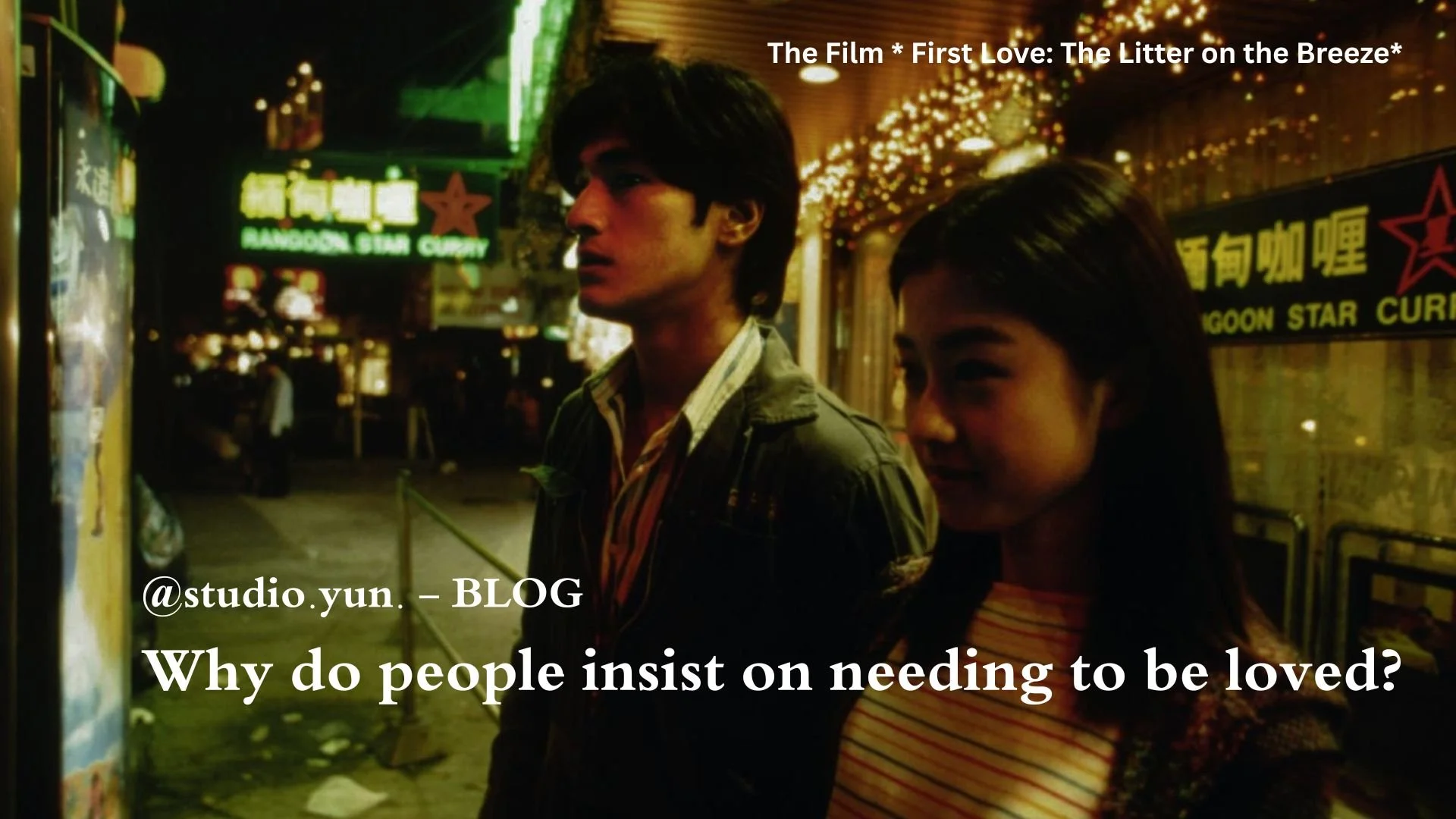
With my thoughts surging, I suddenly thought of a classic Hong Kong literary film released in 1997, First Love: The Litter on the Breeze. An experimental Hong Kong literary film, it was directed by Eric Kot, produced by Wong Kar-wai, photographed by Christopher Doyle, and co-written by Ye Nim-sum and Chan Hoi-kei. Jointly produced by Jet Tone Film Production and other institutions, the film stars Eric Kot, Karen Mok, Takeshi Kaneshiro and Lee Wei-wei. The film is divided into two independent yet interconnected chapters. The first part tells the pure urban first love story between a sleepwalking girl and a mentally ill cleaner, simple yet absurdly tender. The second part depicts the tangled, love-hate entanglements of a pair of former lovers who reunite after a long separation.
With his unique stylized lens language, the director subtly contrasts the ignorant and innocent first love with the complicated romance of reunited lovers who have experienced worldly hardships, creating a strong visual and emotional contrast. However, the two distinct stories share the same core: the two pairs of protagonists, with completely different identities, circumstances and experiences, all have an intense inner desire — they are all eager to be loved, understood and tenderly cared for.
The emotions in the first half of the film are pure heart palpitations bred from curiosity and yearning for unknown feelings and unknown hearts in youth. The emotions in the second half are the lingering and captivating attraction of unresolved past love and regrets after separation. Through the director’s delicate lens depiction and layout, we can clearly see the gradual convergence of the two pairs of protagonists’ moods and their overlapping desires for love and care. Through numerous subtle scenes, silent gazes and wordless interactions, we can accurately capture the connection of their souls and the emotional dialogue that spans the story and time.
This film seems to be born to answer the soulful question raised by the podcast: What do people pursue all their lives — sincere and passionate love, or just the illusory feeling of being loved? Those in first love indulge in the novelty of unknown relationships and cling to the ignorant throbs of the heart; those reunited after separation are trapped in the fetters of old memories and regrets, unable to let go of past emotions. Essentially, both persistently demand attention, care and tenderness from the outside world. Yet we must eventually understand that the fleeting joy of being noticed is never equivalent to true love.
Unconsciously, the morning sun has spread all over the streets, the sky is fully bright, and the podcast ends just at this moment. I slowly take off my headphones, looking at the bright daylight in front of me, and suddenly gain a thorough insight: Perhaps our persistent desire to be loved never stems from our imperfection, but from the fact that love is the gentlest way for us to know and see ourselves. Through the eyes, recognition and love of others, we can walk out of inner confusion and see the complete version of ourselves clearly and truly for the first time.
I always believe that the ultimate meaning of growth is to learn two-way tenderness. May we one day stop only clinging to being noticed, cherished and favored, and instead have a tender and brave heart, learning to take the initiative to understand, tolerate, notice and love others sincerely.
Redefine me
It All Begins Here
Courage
A noun.
According to the Cambridge Dictionary, courage is the ability to control your fear in a dangerous or difficult situation.
It's funny how a single word can change its meaning.
When I was younger, I thought courage belonged to people who climbed mountains, gave speeches, or made life-changing decisions without hesitation. I thought courage looked confident.
This year taught me something completely different.
Sometimes courage is invisible.
It's answering a phone call you don't want to answer. It's getting out of bed when your thoughts are heavier than your body. It's smiling at people while quietly trying to understand a version of yourself you've never met before.
Looking back, this year wasn't defined by one terrible event. It was made up of small moments that slowly changed me.
My family was going through a difficult season, and somewhere along the way, I realized I was too.
Without noticing it, I became someone who kept everything inside. Every doubt, every fear, every disappointment, every small victory—I stored them away instead of talking about them.
I used to be the opposite.
If something happened, I would tell someone. Speaking about it made it feel lighter. But as I grew older, I started convincing myself that sharing my feelings only made life heavier for other people. So instead of asking for support, I learned how to say, "I'm okay," even when I wasn't.
At first, it felt like maturity.
Eventually, it became loneliness.
Around the same time, my confidence quietly disappeared.
Not all at once, but piece by piece.
I questioned my major, my career, my body, my friendships, and even whether I deserved the opportunities I had worked so hard for. From the outside, life looked normal. Inside, I constantly felt like I was falling behind a version of myself I could no longer find.
One of the moments that has stayed with me happened on my nineteenth birthday.
I received a call from home.
My family had gone to visit my grandfather, and during the conversation they told me something I wasn't prepared to hear.
He didn't remember me anymore.
There wasn't a dramatic moment. No tears. No grand realization.
Just silence.
For the first time, I understood how fragile memories are. Someone who had watched me grow up could no longer remember the little girl I used to be.
Strangely, at the same time, I felt like I couldn't remember her either.
Looking back now, I think that moment became a turning point—not because it solved anything, but because it forced me to accept that some chapters of life cannot be controlled. Some losses don't have solutions. All you can do is decide how you'll continue living after them.
That was easier said than done.
I spent weeks avoiding people. I stayed home, wrote scripts, watched films, and let myself become quiet.
For someone who has always loved conversations, spontaneous plans, and being surrounded by people, it felt completely unlike me.
But maybe I needed that silence.
It gave me enough space to ask myself a difficult question:
"If I don't believe in myself anymore, who will?"
The answer wasn't immediate.
Healing rarely is.
Instead, it started with small decisions.
I dyed my hair a completely different color.
I stopped apologizing for every decision I made.
I slowly began trusting my own voice again instead of waiting for someone else to tell me who I should become.
Those moments probably looked insignificant to everyone else.
To me, they were proof that I was finding my way back.
When I think about courage now, I don't picture someone fearless.
I picture someone choosing to keep moving despite uncertainty.
Someone learning to be kinder to themselves.
Someone accepting that confidence isn't something you have forever—it's something you rebuild, again and again.
I'm still rebuilding.
Some days are easier than others.
But maybe that's the point.
Maybe courage isn't the absence of fear.
Maybe it's deciding that fear doesn't get to write the rest of your story.
And if this year taught me anything, it's that even after losing confidence, losing certainty, and almost losing myself...
there is still a way back.